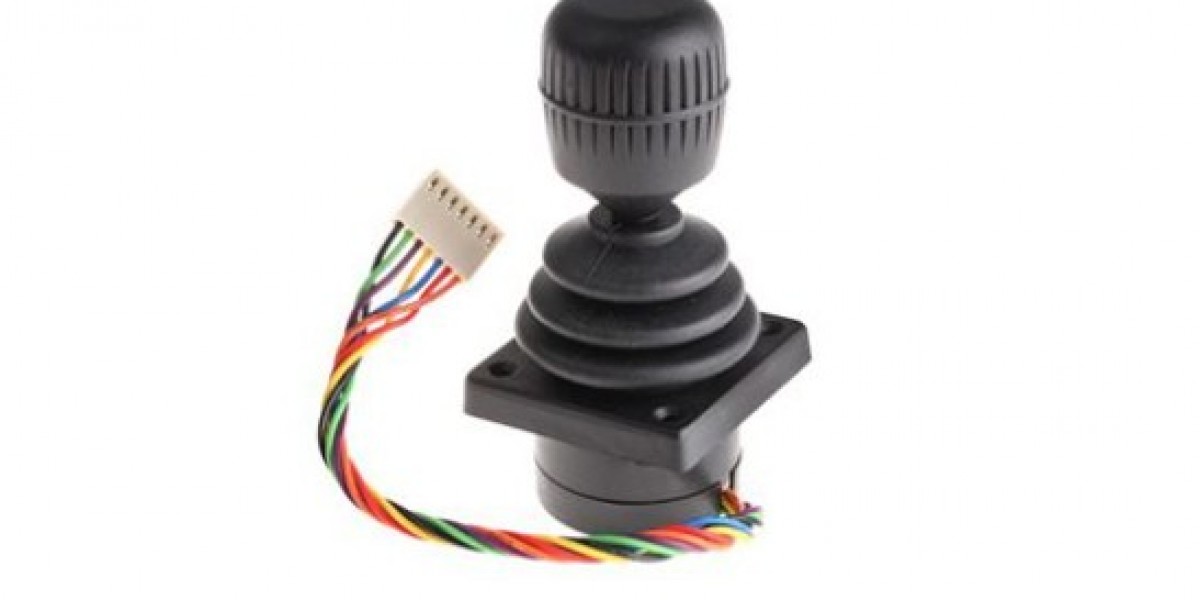

In industrial automation, operator input becomes part of the control loop the moment motion is commanded manually. The joystick is no longer a simple interface but a sensing element that defines how accurately intent is translated into speed, direction, and positioning. A Hall Effect Joystick uses contactless magnetic sensing to generate this command signal, which allows the control system to receive a stable, repeatable input even as equipment operates through vibration, temperature variation, and long duty cycles.
For experienced engineering teams, the advantage of a Hall Effect Joystick is found in how consistently it behaves over time. Because the sensing method does not rely on mechanical contact, the output remains aligned with its original scaling and neutral reference. This supports smoother motion, more predictable commissioning, and long-term control stability without requiring compensating adjustments as components age.
How a Hall Effect Joystick Generates a Position Signal
A Hall Effect Joystick measures position by using a small magnet and a solid-state Hall sensor that move relative to each other as the handle is pushed. As the magnetic field shifts, the sensor produces an electrical output that represents axis position, which the controller reads as a proportional command for speed, direction, or rate. In industrial systems, that output is often ratiometric to the supply or conditioned for stability, so the signal remains dependable when supply voltage varies slightly, temperatures change, and electrical noise is present around drives and switching loads.
The practical advantage shows up at the controller input, where the same physical movement continues to map to the same electrical values after long duty cycles. That stability supports clean scaling, predictable deadband at center, and repeatable endpoints across the full travel range, which matters when operators rely on low-speed feathering and accurate return to neutral. When the signal remains consistent, engineers can commission with confidence and preserve motion feel without repeatedly reshaping command curves to compensate for input variation.
How Contactless Sensing Maintains Signal Accuracy
Contactless sensing keeps signal accuracy stable because the measurement does not depend on sliding electrical contact surfaces that can change with wear or contamination. With fewer mechanical influences inside the sensing path, the output remains more consistent in linearity, neutral centering behavior, and hysteresis, which helps the control system interpret small input changes the same way over time.
Why Signal Consistency Matters in Industrial Control Systems
In industrial control systems, input consistency is what allows motion behavior to remain predictable when equipment is operated by different people, on different shifts, and under different loads. A Hall Effect Joystick provides a steady proportional reference that the controller can scale and filter in a repeatable way, which supports smooth transitions, stable acceleration behavior, and reliable positioning during manual control. When the joystick response is consistent, control parameters can be set for performance instead of being softened to accommodate uncertainty in the command signal.
Signal consistency also reduces the hidden operational cost that comes from small variations in feel. When neutral behavior is predictable and the output changes evenly with handle movement, operators spend less effort correcting motion, and technicians spend less time chasing small differences after service. For automation teams, this translates into clearer commissioning baselines at the controller input and more confidence that the system will return to the same response after replacements, wiring work, or routine maintenance.
Where Stable Input Signals Deliver the Most Value
Stable joystick signals deliver the most value in low-speed positioning, repetitive alignment work, and direction changes under varying load, because these tasks depend on clean proportional response and a reliable neutral reference at the controller input.
Durability and Lifecycle Advantages of a Hall Effect Joystick
Industrial joystick assemblies see continuous mechanical handling, vibration exposure, and temperature variation, which is why long-term durability is closely tied to how the sensing method behaves as hours accumulate. A Hall Effect Joystick reduces the wear mechanisms that typically influence signal quality over time, because the sensor reads magnetic position without needing direct electrical contact in the measurement path. This helps the output remain stable as the handle is used repeatedly, particularly in applications with frequent micro movements around the center.
From a lifecycle perspective, consistent signal behavior improves serviceability. Commissioning baselines for neutral, mid travel, and full travel remain meaningful longer, which allows maintenance teams to confirm performance quickly after service and restore expected behavior without extended trial and adjustment. This supports longer intervals between recalibration activities and helps keep machine response consistent as equipment ages and operating conditions change.
How Reduced Mechanical Wear Supports Long-Term Reliability
By avoiding sliding electrical contacts, the joystick is less likely to develop the small wear-driven shifts that change how neutral feels or how smoothly the signal ramps with handle movement. Over long duty cycles, this helps keep neutral, proportional response, and full-travel endpoints consistent at the controller input, so scaling stays accurate and day-to-day control feel does not gradually drift.
Integration and Commissioning Considerations for Hall Effect Joystick Installations
Integration is where a Hall Effect Joystick becomes a dependable input at the controller rather than a variable that operators feel and technicians have to compensate for. Output type, signal range, and reference behavior should match the controller input design so scaling is accurate across the full travel range, and neutral sits inside a defined window. Wiring practices matter as well, because routing, grounding, and shielding determine whether electrical noise appears as small command changes at low speed, which is where the system is most sensitive to input stability.
Commissioning should establish controller-side baselines that can be repeated later. Teams typically verify neutral value and neutral window, confirm proportional response across travel, and validate that endpoints map to expected command limits under installed conditions. Recording these values makes post-service verification practical, because technicians can confirm the joystick is behaving as commissioned before motion tuning or control changes are considered.
What to Verify During Startup
Startup verification should confirm a stable neutral value at the controller input, smooth proportional response with predictable scaling, and repeatable endpoint values that align with command limits under real installation conditions.
Why Choose ETI Systems for Hall Effect Joystick Applications
ETI Systems supports industrial automation teams that rely on consistent operator input in environments where vibration exposure, long duty cycles, and frequent manual control are normal operating conditions. Their Hall Effect Joystick solutions are selected and supported with a control-minded perspective, focusing on stable electrical behavior, repeatable centering, and signal characteristics that remain predictable at the controller input as equipment accumulates service hours. This helps teams maintain a familiar control feel across shifts and keep manual motion aligned with the response established during commissioning.
ETI Systems supports joystick projects with field-focused guidance that helps teams translate a product specification into predictable controller-side behavior. Their support centers on practical interface alignment, repeatable scaling that maintenance can confirm, and simple verification steps that confirm neutral windows and endpoint values after service work. With those elements in place, teams can maintain consistent control response through routine repairs, replacements, and system growth without adding unnecessary process overhead.
Frequently Asked Questions
What is a Hall Effect Joystick?
A Hall Effect Joystick uses magnetic sensing to measure handle position without mechanical contact, providing a stable proportional signal to the control system.
Why are Hall Effect Joysticks used in industrial applications?
They deliver consistent output, reduced wear, and reliable performance in environments with vibration, temperature variation, and continuous operation.
How does a Hall Effect Joystick improve control consistency?
Maintaining stable proportional output and neutral reference allows the controller to interpret operator input the same way over time.
What should be checked during commissioning?
Neutral position, proportional response, and endpoint values should be verified at the controller input and recorded as reference baselines.
How does ETI Systems support Hall Effect Joystick integration?
ETI Systems supports integration through durable product design, control-focused guidance, and verification practices that help maintain long-term performance.