
Electrical measurements often involve determining current, voltage, or resistance. However, in many laboratory experiments, engineers and physicists need to measure the total quantity of electric charge that flows through a circuit in a very short time. This is where a ballistic galvanometer becomes useful.
A ballistic galvanometer is a specialized measuring instrument designed to detect and measure small quantities of charge passing through a circuit. It is commonly used in physics and electrical engineering laboratories for experiments involving capacitance, magnetic flux, and electromagnetic induction.
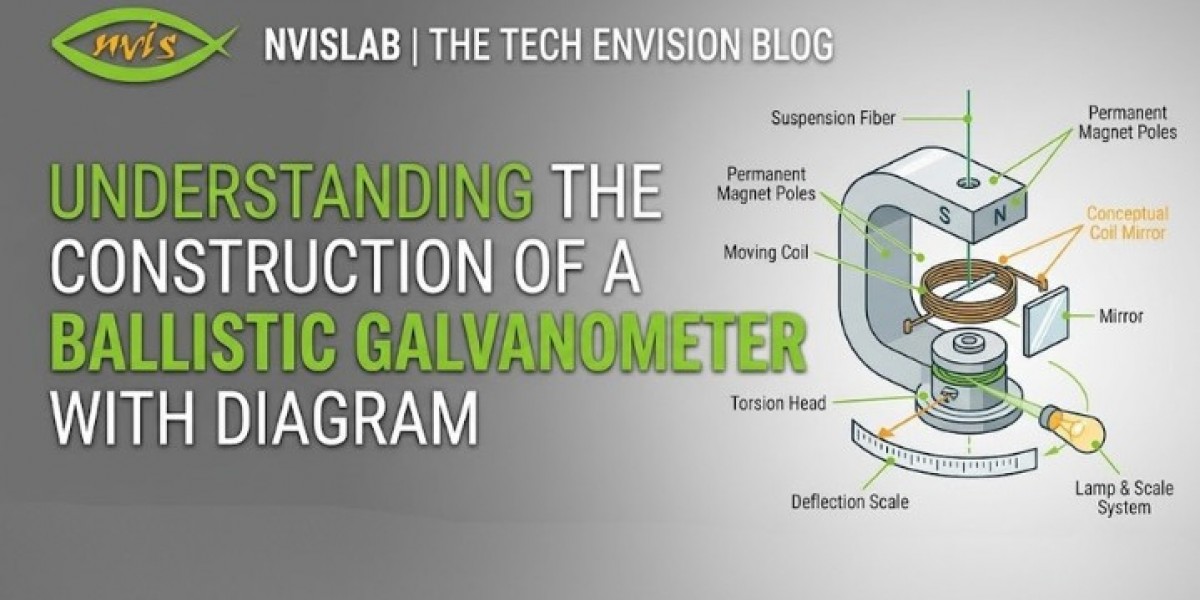
Understanding the construction of a ballistic galvanometer helps students appreciate how its design enables accurate charge measurement.
What Is a Ballistic Galvanometer?
A ballistic galvanometer is a moving-coil instrument that measures the total charge flowing through its coil during a brief current pulse. Unlike an ordinary galvanometer that measures steady current, a ballistic galvanometer responds to the total charge transferred.
When a short current pulse passes through the coil, the coil receives an impulse and swings to a maximum deflection. The magnitude of this first deflection is proportional to the quantity of charge that has passed through the instrument.
Construction of a Ballistic Galvanometer
The construction of a ballistic galvanometer is based on the moving-coil principle. However, certain modifications are made to improve its ability to measure charge accurately.
Main Components
1. Permanent Magnet
A strong horseshoe-shaped permanent magnet produces a uniform radial magnetic field.
Functions:
Provides a magnetic field for coil movement.
Ensures linear deflection characteristics.
Improves measurement accuracy.
2. Moving Coil
A rectangular coil made of fine insulated copper wire is suspended between the poles of the permanent magnet.
Functions:
Carries the current pulse.
Experiences a torque when charge passes through it.
Produces angular displacement proportional to the charge transferred.
3. Soft Iron Core
A cylindrical soft iron core is placed inside the coil.
Functions:
Concentrates magnetic flux.
Creates a stronger and more uniform magnetic field.
Enhances instrument sensitivity.
4. Suspension Fiber
The moving coil is suspended using a thin phosphor-bronze strip or quartz fiber.
Functions:
Supports the moving system.
Provides a restoring torque.
Allows smooth oscillatory motion.
5. Mirror and Scale Arrangement
A small mirror is attached to the moving coil. A beam of light is reflected from the mirror onto a calibrated scale.
Functions:
Eliminates parallax error.
Allows precise measurement of deflection.
Increases reading accuracy.
6. Damping System
Ballistic galvanometers are designed with minimal damping.
Functions:
Allows the coil to swing freely.
Ensures the first maximum deflection can be measured accurately.
Prevents energy loss during charge measurement.
7. Terminal Connections
External terminals are provided to connect the instrument within an electrical circuit.
Functions:
Allow current pulses to pass through the coil.
Enable integration with laboratory experiments.
Ballistic Galvanometer Diagram
The basic construction can be represented as follows:
Light Source
|
V
Mirror
|
-----------------
| |
| Moving Coil |
| |
-----------------
Soft Iron
Core
N S
Permanent Magnet Poles
|
Suspension Fiber
|
Scale
Labeled Parts
Permanent Magnet
Moving Coil
Soft Iron Core
Suspension Fiber
Mirror
Scale
Terminal Connections
Why Is the Coil Made Heavier?
One of the most important construction features is the heavier moving system.
Advantages:
Increases the moment of inertia.
Produces a longer oscillation period.
Ensures the entire charge passes through before significant movement begins.
Improves charge measurement accuracy.
Importance of Low Damping
In a ballistic galvanometer, damping must be kept very small.
If excessive damping is present:
The coil loses energy.
First deflection decreases.
Charge measurements become inaccurate.
Therefore, eddy current damping is minimized during construction.
Working Principle Based on Construction
The construction directly supports the operating principle.
A short current pulse passes through the moving coil.
The magnetic field interacts with the current-carrying coil.
The coil experiences an impulsive torque.
The moving system swings to a maximum deflection.
The first swing is proportional to the total charge passed.
The restoring torque from the suspension fiber brings the coil back toward its equilibrium position.
Applications of Ballistic Galvanometer
Due to its specialized construction, the ballistic galvanometer is widely used in laboratories and educational institutions.
Applications include:
Measurement of electric charge.
Determination of capacitance.
Measurement of magnetic flux.
Study of electromagnetic induction.
Calibration of electrical instruments.
Physics laboratory experiments.
Electrical engineering training and demonstrations.
Advantages of Ballistic Galvanometer
High sensitivity.
Accurate charge measurement.
Suitable for transient current analysis.
Useful in educational laboratories.
Simple operating principle.
Limitations of Ballistic Galvanometer
Not suitable for measuring continuous current.
Sensitive to mechanical vibrations.
Requires careful calibration.
Largely replaced by modern electronic instruments in industrial applications.
Conclusion
The construction of a ballistic galvanometer is specifically designed to measure the quantity of electric charge passing through a circuit. Components such as the moving coil, permanent magnet, soft iron core, suspension fiber, and mirror-scale arrangement work together to provide accurate charge measurement. Features like a heavier moving system and minimal damping distinguish it from ordinary galvanometers and enable it to measure transient electrical phenomena with high precision. Understanding its construction is essential for students studying electrical engineering, electronics, and experimental physics.