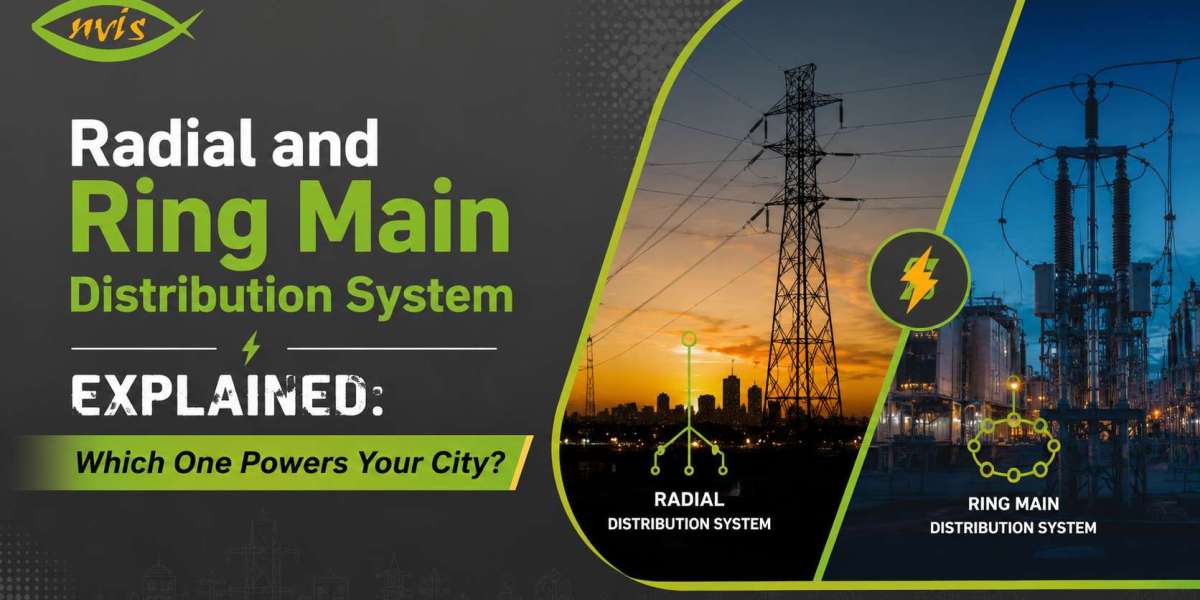

The radial and ring main distribution system forms the backbone of how electricity travels from a substation to homes, shops, and factories. Every consumer connection, whether in a village or a metro city, is built on one of these two basic layouts. Understanding how they differ is fundamental to electrical power system design, and it is a recurring topic in GATE, SSC JE, and RRB JE examinations.
This blog breaks down both systems in plain language, starting with the intuition before the technical terms. You will learn how power actually flows through each system, what happens during a fault, why Indian DISCOMs are shifting toward ring topology, and how this knowledge connects to real career opportunities in the power sector.
What Is a Power Distribution System, Really?
Think about how water reaches your home. A large pipeline brings water from the treatment plant to your area, and then smaller pipes branch off to each house. Electrical power distribution works the same way.
Power is generated at a power plant, stepped up to a very high voltage for long-distance transmission, and then stepped down again near your city through a substation. From that substation, the electricity still needs to reach individual streets, buildings, and finally your switchboard. This final stretch, from the substation to your meter, is called the distribution system.
The distribution system typically includes feeders (the main lines carrying power away from the substation), distribution transformers (which step voltage down further for local use), distributors (which tap power off to consumers), and service mains (the final connection into a building). How these feeders and distributors are arranged, in a straight line or in a loop, decides whether you are looking at a radial system or a ring main system.
Radial Distribution System: The Single-Lane Road
Picture a single-lane road that starts at a highway and ends at a small village with no way back. If a tree falls anywhere on that road, everyone beyond the fallen tree is stuck. That is exactly how a radial distribution system behaves.
In a radial distribution system, feeders radiate outward from a single substation like the branches of a tree, and power flows in only one direction, from the source toward the consumer. Each distributor is connected to the substation through just one feeder, with no backup path. This is why it is called radial, since the layout resembles spokes moving away from a central hub.
This simplicity is also its biggest strength. A radial system needs the least amount of cable, the fewest switching devices, and the lowest number of protection components, which keeps installation costs low. That is why radial systems are the default choice for rural areas, small towns, and any location where the substation sits at the center of a scattered, low-density load.
Advantages of Radial Distribution System
A radial system wins on cost and simplicity. Since there is only one path from source to consumer, the amount of conductor, switchgear, and protective equipment required is minimal. Voltage drop calculations and fault analysis are also far easier, because power flows in a single, predictable direction. For a rural feeder serving scattered villages, this straightforward design makes both installation and maintenance planning simpler for the DISCOM.
Disadvantages of Radial Distribution System
The one-directional design that keeps costs low is also what makes a radial system fragile. If a fault occurs anywhere along the feeder or a distributor, every consumer downstream of that point loses supply immediately, since there is no alternative route for power to reach them. Consumers at the far end of a long distributor also face noticeable voltage fluctuations whenever the load changes, since they are the farthest point from the source with no support from another direction. Because of these limitations, radial systems are generally restricted to short distances and lower-priority loads.
Ring Main Distribution System: The Roundabout That Never Dead-Ends
Now picture a roundabout instead of a dead-end road. Even if one section gets blocked, traffic can still reach every exit by going the other way around. That is the core idea behind a ring main distribution system.
In a ring main system, the feeder starts at the substation, loops through the entire service area connecting every distribution transformer along the way, and returns to the same substation, forming a closed loop. Because the loop closes back on itself, every distribution transformer on the ring is fed from two directions instead of one. If a fault develops in any section of the ring, that damaged section can be isolated using circuit breakers, while power continues to flow to every consumer from the opposite direction.
This is precisely why ring main systems are the preferred choice for urban and semi-urban distribution networks in India today, where population density is high and even a brief outage affects thousands of consumers at once.
Advantages of Ring Main Distribution System
The biggest advantage of a ring main system is reliability. Since each distribution transformer receives power through two feeder paths, a fault on one side does not interrupt supply, because the other side of the ring keeps delivering power. Voltage regulation also improves significantly, since consumers are no longer dependent on a single long feeder and the voltage drop is shared across two paths instead of one. This dual-path structure also allows for a smaller conductor cross-section for the same load, since current is split between two routes, which translates into real savings on copper and aluminum over a large network. Maintenance becomes far less disruptive too, since a section of the ring can be isolated for repair work without switching off supply to the rest of the area.
Disadvantages of Ring Main Distribution System
None of this reliability comes for free. A ring main system requires considerably more cable length, additional switchgear such as ring main units, and more sophisticated protection coordination, all of which push up the initial installation cost compared to a radial layout. Because power can flow in either direction around the loop, protective relays need to be set up carefully to detect faults correctly regardless of which direction the fault current is coming from, which makes the design and commissioning process more technically demanding. Fault location and restoration in a ring can also take more planning than in a simple radial layout, since engineers first need to identify exactly which ring section has failed before isolating it.
Radial vs Ring Main Distribution System: Side-by-Side Comparison
Parameter | Radial Distribution System | Ring Main Distribution System |
Power flow direction | Single direction only | Bidirectional, from two paths |
Reliability | Low, one fault can cut off all downstream consumers | High, faulty section can be isolated without full outage |
Initial cost | Low, minimal cable and switchgear | Higher, extra cable, breakers, and ring main units needed |
Voltage regulation | Poor at the far end of the feeder | Good, since each point is fed from two directions |
Protection design | Simple, single direction fault current | Complex, needs bidirectional fault detection |
Best suited for | Rural areas, small towns, scattered loads | Urban areas, high-density zones, industrial clusters |
Conductor size needed | Larger, since current flows through one path only | Comparatively smaller, since current splits across two paths |
Maintenance impact | Repairs usually mean a temporary outage | Repairs possible with minimal disruption to supply |
What Happens During a Fault: A Practical Walkthrough
Understanding the theory is one thing, but seeing how each system actually behaves during a fault makes the difference click.
Suppose a distributor in a radial system develops a fault three poles away from the substation. Since there is only one feeder supplying that stretch, the protective fuse or circuit breaker nearest to the substation trips, and every consumer connected beyond that point, including everyone farther down the line, loses power until the fault is repaired.
Now consider the same fault occurring on one section of a ring main system. The ring feeder is supplied from the substation at both ends of the loop, so protective devices on either side of the faulty section detect the problem and isolate just that segment. Every other distribution transformer on the ring keeps receiving power, either from the original direction or from the opposite direction around the loop. Consumers on the healthy sections may not even notice the fault occurred, while repair crews work on the isolated segment.
This single scenario explains why DISCOMs across Indian cities are increasingly converting radial feeders into ring or interconnected systems, especially in areas where even short outages carry a high cost in terms of consumer complaints and revenue loss.
Why This Matters for India's Power Sector Right Now?
India's distribution sector is going through one of its biggest infrastructure overhauls in decades. The Revamped Distribution Sector Scheme, approved by the Cabinet Committee on Economic Affairs, carries an outlay of roughly Rs 3.03 lakh crore spread across DISCOMs nationwide. A significant share of this outlay is directed at exactly the kind of network strengthening this blog covers, including substation modernization, replacement of conductors and transformers, and feeder segregation projects aimed at reducing losses and improving reliability.
The results are already visible in the numbers. Aggregate Technical and Commercial losses, which reflect the gap between electricity supplied and revenue realised, have dropped from 21.91 percent in FY21 to 16.12 percent in FY24, a decline credited in large part to this infrastructure push. Feeder segregation and network reconfiguration, converting older radial layouts into ring or interconnected topology, sit right at the center of this improvement.
For students, this is not just theory sitting in a textbook. Every DISCOM tender for feeder augmentation, every SCADA-based automation project, and every Ring Main Unit installed in an urban substation is a direct, real-world application of the concepts covered in this blog. Standards bodies also formalize this shift, with IEC 61936 and IEEE 141 standards recommending ring main units for medium-voltage applications, and modern ring main systems are increasingly built around SCADA-integrated switchgear from manufacturers like ABB and Schneider Electric for faster fault detection and restoration.
Conclusion
Radial and ring main distribution systems represent two fundamentally different philosophies for delivering power, one built around simplicity and low cost, the other built around resilience and continuity of supply. A radial system works well when a fault affecting a few consumers is an acceptable risk, while a ring main system is built for situations where even a brief outage is unacceptable, which describes most of urban India today. Understanding how each system responds to a fault, what it costs to build and maintain, and where each one fits best gives you a genuinely practical grasp of electrical distribution engineering, not just a memorized definition. This knowledge pays off twice over, first in scoring reliably on GATE, SSC JE, and RRB JE papers, and later in understanding the actual feeder network you might one day help design, operate, or upgrade as a DISCOM or PSU engineer. As India's RDSS-driven infrastructure push continues to convert more radial feeders into ring and interconnected networks, this is exactly the kind of foundational concept worth mastering early in your engineering journey.