
You download a German app, learn a few greetings, memorize the numbers, and think, "This isn't so difficult." Then you meet a sentence with three verbs in it, scattered like someone dropped a deck of cards. Suddenly der, die, and das feel less like grammar and more like a personal attack.
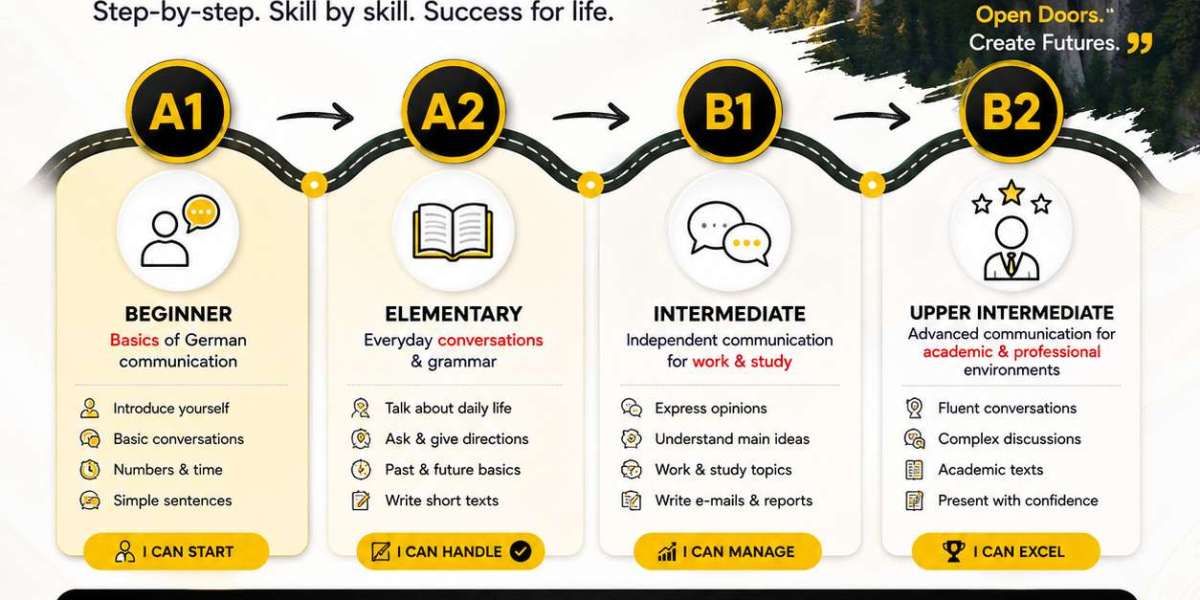
Nobody warns you about this part. Most blogs sell the dream: fluent in six months, one easy system, just show up and repeat. What they skip is the messy middle: the plateau at A1, the wall at B1, the confidence dip right when you should be improving. If you're about to start a German language course a1 to b2, here's what people usually only tell you after they've survived it.
German Grammar Isn't as Scary as It Looks — But It's Different
German grammar isn't harder than English. It's built on different logic, and your brain hasn't formed the shortcuts yet. English tolerates loose word order. German rewards precision. The verb sits in a fixed spot, cases change how nouns behave, and word order shifts with emphasis.
Once the pattern clicks, it becomes predictable in a way English never is. You stop guessing and start applying rules. That shift, from memorizing to reasoning, is usually the first sign you're past the beginner stage.
Why Articles (der, die, das) Confuse Everyone at First
Nobody has a foolproof formula for guessing gender in German. Der Tisch, die Lampe, das Buch. There's no consistent logic linking "table," "lamp," and "book" to their articles. New learners hunt for a rule that doesn't fully exist.
What works instead is learning nouns with their article attached from day one, the way you'd learn a name attached to a face. Not "Tisch," but "der Tisch." Say it enough as one unit and the article stops feeling separate.
A1 Feels Slow — And That's Completely Normal
A1 can feel like wading through mud. You're learning to introduce yourself, order coffee, talk about your daily routine, useful, but nowhere near what you imagined when you decided to learn a language. Progress here is invisible day to day, obvious only in hindsight, usually when you notice you read a menu without translating it first.
The Motivation Dip Most Beginners Don't Expect
Here's the part almost nobody mentions: the excitement of week one fades by week four, right before the payoff arrives. You've learned enough to know how much you don't know, and that gap feels discouraging. Learners who quit German usually quit here, not because it's too hard, but because it stopped feeling like progress.
The fix isn't more willpower. It's structure: someone tracking your progress against a syllabus so you can see the climb even when it doesn't feel like one. This is where a structured online german language course earns its keep.
Speaking Comes Before Confidence, Not After
Almost every learner waits to "feel ready" before speaking German out loud. That moment never arrives on its own. Confidence isn't a prerequisite for speaking. It's a byproduct of having already spoken badly, and survived it.
Why Waiting to "Feel Ready" Holds You Back
Wait until your grammar is clean before you speak, and you'll wait for years. Fluent speakers didn't wait. They mangled sentences in front of real people and kept going. The learners who progress fastest treat mistakes as data, not embarrassment. That's why live practice matters more than another vocabulary app; you need a human who corrects you mid-sentence, not an algorithm grading you after the fact.
The Jump from A2 to B1 Is Where Most People Quit
A2 feels like a plateau you've settled into. You hold basic conversations, read simple texts, get through daily situations without panic. Then B1 resets the difficulty: longer sentences, subjunctive mood, opinions instead of facts.
What Changes at B1 That Catches Learners Off Guard
Aspect | A2 Level | B1 Level |
Grammar complexity | Simple present, past tense basics | Subjunctive, passive voice, complex clauses |
Vocabulary range | Everyday situations | Opinions, abstract topics, workplace terms |
Speaking expectations | Short exchanges | Sustained conversation, giving reasons |
Listening difficulty | Slow, clear speech | Natural speed, regional variation |
The jump isn't "more words." It's a shift from reciting language to using it to think. That discomfort is exactly what makes people quit at this stage rather than push through it.
B2 Isn't Just Vocabulary — It's a Mindset Shift
By B2, the goal stops being "communicate" and becomes "communicate naturally." You're expected to argue a point, follow fast native conversation, and read humor and tone, not just literal meaning. Vocabulary alone won't get you there. Exposure does.
How to Prepare for Real-World German Conversations
Watch German shows without subtitles, even at sixty percent comprehension. Read short news articles daily instead of long ones occasionally. Talk to native speakers who won't slow down for you, because real German doesn't slow down either. The goal at B2 isn't perfection, it's staying in the conversation when it moves fast.
What Actually Helped Learners Go From A1 to B2 Faster
Speaking from week one, even in broken sentences, instead of waiting to "know enough"
Learning nouns with their article attached, never as a standalone word
Practicing listening daily: five minutes a day beats an hour once a week
Keeping a small notebook of mistakes and reviewing it weekly
Choosing a structure that forces regular speaking, not just grammar drills
Setting a fixed weekly schedule instead of "whenever I have time"
Why the Right Guidance Makes the A1 to B2 Journey Easier
A self-taught path works for some people, but most learners underestimate how much a structured german language course a1 to b2 shortens the plateau stages. This is where YesGermany's approach makes a visible difference for learners across India, whether they're studying German classes online or attending sessions in person in one of the cities where classes run.
Certified trainers who've actually taught the A2-to-B1 wall, not just the easy stages
Batches flexible enough to fit around jobs and college schedules
Live speaking practice built into every level, not an optional extra
A structured path from A1 straight through to B2, no stitching random courses together
Feedback loops that catch small grammar habits before they harden into bad ones
A learner community that keeps the motivation dip from becoming a full stop
If you've ever wondered whether learn German online actually works as well as in-person classes, the honest answer is: it depends entirely on the structure behind it, not the format itself.
Your Next Step
German rewards people who keep showing up more than it rewards short bursts of hard work. The plateau at A1, the wall at B1, the mindset shift at B2, none of it means you're doing something wrong. It's just what the climb looks like.
Curious how a structured german language course a1 to b2 could shorten yours?
If you're ready to stop guessing your way through grammar and start speaking with real feedback, YesGermany runs a free demo class, and you can sit in on an actual german language training online session before committing to anything. Book it, ask the trainer what this article couldn't answer, and see what your next stage of German actually looks like.