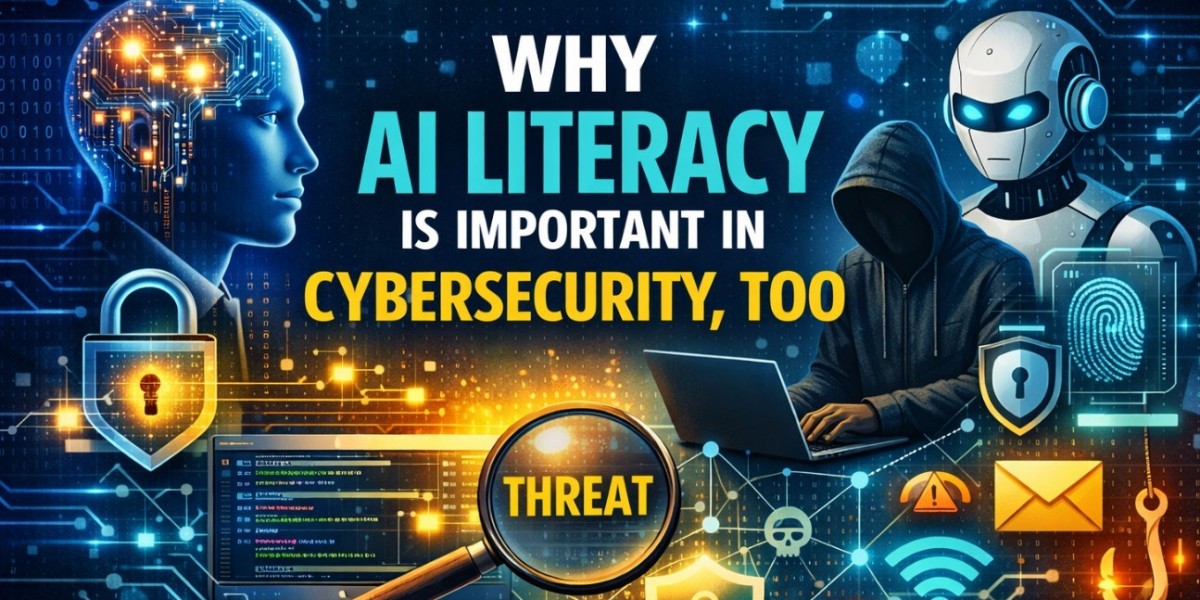

The use of artificial intelligence has increased for both attack and defense. Also, professionals and executives from across departments must know that the war in the digital world is not just confined to code but also to real intelligence. With attackers actively employing AI tools and tactics in their attack strategies, it is AI literacy that will help cybersecurity professionals stay ahead of the criminals.
Be it advanced threat detection, behavioral analytics, or automated incident response, the importance of AI in cybersecurity cannot be understated. This makes AI literacy, just like cybersecurity certification, an important skill in battling emerging and AI-powered cyberthreats.
What is the Role of AI in Modern Cybersecurity?
Gone are the days of traditional cybersecurity measures. Today, AI has been deeply integrated across major security operations. Cybersecurity professionals use machine learning models to analyze huge volumes of network traffic, identify anomalies, detect zero-day attacks, and reduce false positives. AI-powered security solutions and security operations centers (SOC) can automate alerts, prioritize risk, and significantly improve response times.
Cybersecurity course in 2026 have integrated curriculum highlighting the importance and application of AI in cybersecurity.
With AI literacy, security teams can learn how these systems work and what their limitations are. Without this understanding, security professionals may blindly trust AI, which could further escalate the issues.
Therefore, AI literacy is highly important as this technology can be used both as a weapon as well as a shield.
Offensive AI (The Threat) | Defensive AI (The Solution) | |
Speed | Automated vulnerability discovery. | Real-time threat detection and response. |
Scale | Thousands of unique attacks simultaneously. | AI-driven SOCs that filter "alert fatigue." |
Deception | Deepfakes and automated social engineering. | Behavioral analytics to spot anomalies.13 |
Why is AI Literacy Needed for Cybersecurity?
Here are a few reasons why AI literacy among security professionals can boost and strengthen an organizations security endeavors.
1 Defense against personalized attacks
Earlier, spotting a phishing attack was quite simple through poor grammar and generic greetings that were tell-tale signs. But with advancements in LLMs and generative AI, attackers can create hyper-personalized messages that may seem highly realistic and genuine, like those sent from the CEO or a familiar person.
AI literacy can teach employees to:
- Identify forced urgency recognize common patterns where AI-generated content will try to enforce pressure
- Question context learn if a perfectly written email can also be deceptive and attempt to bypass security.
2 Rise of Deepfakes and Truth Injection
Deepfakes are at their prime now. Highly realistic deepfake audio and video are used to exploit the human factor by attackers. To stay secure from these, AI literacy is one essential cybersecurity skill in 2026 that helps employees understand that what you see doesnt necessarily mean you should believe. It encourages verification through a trusted channel to confirm the request.
3 Securing the AI Supply Chain
Organizations are using AI across almost all business functions. Be it using their own internal LLMs or a third-party AI agent, risks always follows including:
- Prompt injection where malicious prompts trick the AI model to reveal sensitive information
- Data poisoning manipulating the training data that can create vulnerabilities in the model
AI literacy helps security professionals to thoroughly analyze their AI tools. It empowers them to understand how data flows through the model to prevent shadow AI.
4 Strengthening Governance, Ethics, and Compliance
As the regulations are getting stricter on AI, cybersecurity teams can assist their organizations in complying with major data privacy and ethical AI standards. AI literacy enables them to understand:
- Importance of transparent and explainable models
- How bias and fairness can risk security analytics
- How to secure lifecycle management of AI systems
This is non-negotiable in industries like healthcare, finance, and government.
5 Reducing Cybersecurity Skills Gap
Cybersecurity skill shortage is growing. According to Fortinet, cybersecurity job roles requiring AI expertise are among the hardest to fill, with 57% of respondents identifying them as scarce. Though AI cannot replace skilled professionals, it definitely enhances their capabilities.
Organizations offering AI literacy training can create more capable, empowered, and efficient security teams.
AI-Literacy is the Need of the Hour!
At the end, the goal of AI literacy is to empower security professionals and employees to identify, reduce, and thwart modern AI-powered threats with greater efficiency. The most secure organizations in 2026 will be those that encourage human-AI collaboration, invest in effective AI literacy programs, encourage cybersecurity certifications to stay updated, and work with AI to handle threats at speed.
Frequently Asked Questions (FAQs)
- What is AI literacy in cybersecurity?
AI literacy in cybersecurity means understanding how AI and machine learning systems detect threats, analyze data, and help with informed security decisions. It also means understanding the capabilities of AI in cybersecurity and its potential limitations/risks.
- How to become AI literate in cybersecurity?
By learning AI fundamentals, understanding AI-powered threats, using AI security tools, and upgrading with the best cybersecurity certifications and cybersecurity courses, you can gain AI literacy for cybersecurity.
- Is AI literacy required for non-technical cybersecurity roles?
Yes. Even non-technical roles benefit from AI literacy to support governance, compliance, risk management, and informed decision-making around AI-based security solutions.